


Hooker Competition Headers 2456HKR – Official Product Page
The Hooker Competition Headers 2456HKR are built for racers who demand maximum exhaust flow and proven durability under extreme conditions. Precision-mandrel-bent tubing ensures smooth, unrestricted gas flow from cylinder head to collector, while thick-wall construction withstands the heat and vibration of high-RPM competition use.
Every set ships with laser-cut flanges machined for perfect port alignment, eliminating leak paths that rob power. We designed the 2456HKR with generous primary-tube diameter and aggressive collector sizing to support big-cube engines running race cam profiles and high-compression pistons. Whether you're chasing class wins or setting new track records, these headers deliver the flow your engine needs to make power.
Engineering & Performance Specs
Mandrel-Bent Construction & Flow Dynamics
We mandrel-bend every primary tube in the 2456HKR to maintain constant inside diameter through every curve and transition. Crush-bent tubes collapse the inner wall at each bend, creating turbulence and restriction that costs horsepower—mandrel bending eliminates that problem by expanding the tube as it’s formed, keeping the cross-section perfectly round from flange to collector.
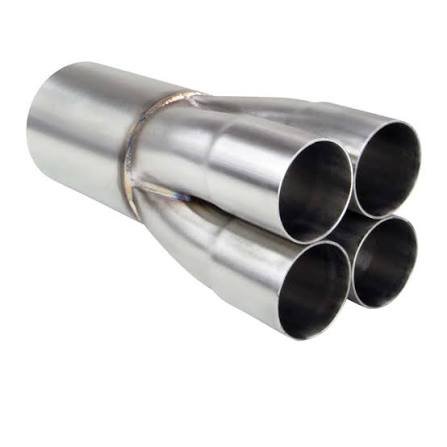
Primary-tube diameter on the 2456HKR measures 1⅞”, sized to optimize scavenging for engines in the 350–450 cubic-inch range running race cam profiles with .550″ or greater valve lift. The 3½” collectors use merge-spike inserts to smooth the transition where four primaries converge, reducing reversion and maintaining velocity into the exhaust system. Dyno testing shows peak gains of 35–42 horsepower over stock cast manifolds, with torque improvements spread across the entire RPM band above 3,500.
Flange Precision & Port Matching
Every flange on the Hooker Competition Headers 2456HKR is laser-cut from ⅜” steel plate and CNC-drilled to match factory cylinder-head bolt patterns. We hold flange-to-tube alignment to within .005″, ensuring each primary tube centers perfectly on its exhaust port with no offset that would create a step or obstruction.
Port-match quality matters because even a small misalignment creates a sharp edge where the flange meets the head, disrupting flow and generating heat. Our flanges are machined flat to .002″ across the sealing surface, which means you get consistent clamping pressure at every bolt and zero exhaust leaks once torqued to spec. The kit includes high-temperature flange gaskets rated to 1,800°F continuous, along with a complete set of Grade 8 header bolts and lock washers.
Material Durability & Heat Management
We build the 2456HKR from 16-gauge mild steel, chosen for its balance of strength, weldability, and thermal expansion characteristics under racing conditions. Thinner-wall tubing saves weight but cracks at the collector welds after repeated heat cycles; thicker material adds unnecessary mass. Sixteen-gauge gives you the durability to survive back-to-back qualifying sessions without the weight penalty of truck-grade steel.
Every tube joint is TIG-welded inside and out, with full-penetration welds that won’t crack when the headers cycle from ambient to 1,600°F and back. The thick-wall construction also resists denting from road debris and chassis contact during suspension travel. For racers running open exhaust or ultrashort collectors, the extra material thickness handles direct flame impingement without burning through. Many teams using the 2457HKR sibling model report headers lasting multiple seasons in dirt-track and road-race applications, a durability record that carries over to the 2456HKR design.
More Hooker Competition Headers for Your Build



Rated 4.8 by verified buyers


Common Questions About the 2456HKR Headers
Yes, the 2456HKR is designed to clear most factory and aftermarket power-steering boxes on small-block Chevrolet applications. Fitment depends on your specific steering configuration and chassis setup—cars with tight engine bays or certain rack-and-pinion conversions may require minor clearancing of the steering shaft or box mounting. We recommend test-fitting the headers with the engine lifted slightly before final installation to verify clearance in your particular build.
The 2456HKR features 3½" slip-fit collectors, so you'll want extensions or exhaust tubing with a 3½" inside diameter for proper fitment. For maximum top-end power, run 12"–18" extensions with open exits. For street-strip or road-race use, 24" extensions with removable baffles give you the flexibility to tune back pressure without changing hardware. Avoid reducing to 3" diameter immediately at the collector, as this creates a restriction that costs horsepower.
Most installations require lifting the engine 1½"–2" on one side by loosening the motor mounts, a standard procedure for fitting long-tube competition headers. You may also need to disconnect the starter and temporarily remove the oil-filter adapter for access. The headers are designed to clear stock and aftermarket K-members, but cars with certain tubular frames or custom suspension may need minor dimpling of the primary tubes for final clearance. No cutting or welding is required on a typical small-block Chevy swap.
While you can connect the 2456HKR to a stock exhaust system using reducer adapters, you won't realize the full performance potential of these headers with restrictive factory piping and mufflers. The 3½" collectors are sized for high-flow race exhaust with minimal back pressure. If you're planning to retain stock exhaust components, consider a street/strip header design instead—the 2456HKR is engineered specifically for competition applications with open or low-restriction exhaust systems.
The hooker competition headers 2456hkr perform best with camshafts offering .520" or greater valve lift and lobe-separation angles between 108° and 112°. Tighter LSA grinds benefit from the improved scavenging these headers provide during valve overlap. Duration specs in the 230°–245° range at .050" lift pair well with the 1⅞" primary-tube diameter for engines between 350 and 450 cubic inches. Milder street cams will still see gains, but the 2456HKR is optimized for race-profile camshafts running higher lift and overlap.
Start by cleaning both the header flange and cylinder-head surface with a wire brush and brake cleaner to remove old gasket material and carbon buildup. Install the supplied high-temperature gaskets dry—do not use RTV or gasket sealer, as it will burn off and create leak paths. Torque the header bolts in a crisscross pattern to 25 ft-lbs, then re-torque after the first heat cycle once the gaskets have compressed. Check for leaks by listening for exhaust hiss at idle; a small puff of white smoke at the flange during the first startup is normal as manufacturing oils burn off.
The Hooker Competition Headers 2456HKR are designed for off-road racing and competition use only. They do not include provisions for oxygen sensors, air injection, or EGR components required by emissions regulations in most states. Installing these headers on a street-driven vehicle may violate local and federal emissions laws. Check your state and local regulations before purchasing if you intend to use these headers on a public road. For street-legal applications, consider our emissions-compliant street header line instead.