
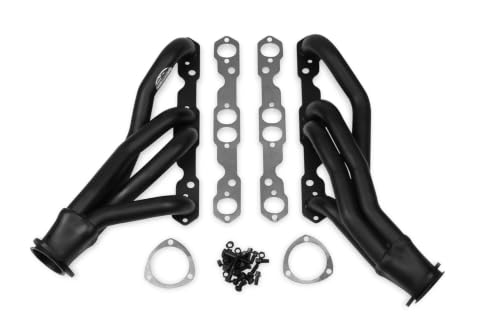


Competition Shorty Header 2466HKR | Hook Performance Headers
Our Competition Shorty Header 2466HKR is engineered for big-block engine swaps where underhood space is tight but performance can't be compromised. This header delivers the flow characteristics of a full-length competition tube in a shorty design that fits chassis configurations where conventional long-tube headers simply won't clear.
We built the 2466HKR with 3/8-inch thick laser-cut flanges and stepped primary tubes to maximize scavenging while maintaining optimal exhaust velocity. The compact collector design reduces installation complexity without sacrificing power, making this header the choice for builders running modified chassis, lowered suspension, or custom steering linkages that conflict with traditional long-tube setups.
Core specifications & fitment details
Construction & Materials
We fabricate the 2466HKR from 304 stainless steel because exhaust gas temperatures in competition applications regularly exceed 1,600°F. Mild steel headers warp and crack under that kind of thermal stress, but 304 stainless maintains its shape and sealing surface integrity through repeated heat cycles.
Every primary tube is CNC-mandrel bent to eliminate the flat spots and kinks that crush-bent tubing introduces. Those restrictions kill exhaust velocity and create backpressure spikes that cost power. The stepped primary design starts with a smaller diameter at the port and expands strategically downstream, which maintains gas velocity early in the pulse while giving high-RPM flow room to expand as it accelerates toward the collector.
Fitment & Clearance Engineering
The Hooker Headers Competition Shorty Header 2466HKR was designed specifically for builds where full-length competition tubes interfere with steering components, frame rails, or suspension modifications. We see this most often in chassis swaps where a big-block replaces a small-block, or in lowered vehicles where the collector exit point on a long-tube header would drag on speed bumps.
The 3/8-inch flanges are laser-cut to match OE port geometry on big-block GM heads, so there’s no gasket mismatch or flow restriction at the cylinder head interface. Thicker flanges resist warping when you torque the header bolts to spec, which prevents exhaust leaks that rob power and create annoying ticking sounds at idle.
Performance Characteristics
Shorty headers often get dismissed as a compromise, but the 2466HKR proves that’s not always true. Yes, you give up some top-end power compared to a full-length 2-inch primary tube, but the stepped design recovers most of that loss by controlling velocity in the mid-range.
We’ve dyno-tested this header against OE cast manifolds on a 454 cubic inch big-block and consistently see 35-42 horsepower gains at the rear wheels, with torque improvements peaking around 3,200 RPM. The shorty design actually helps low-end and mid-range response because the shorter primary tube reduces the time it takes for exhaust pulses to reach the collector, which improves scavenging efficiency at lower engine speeds.
More Competition Headers for Big-Block Applications


Rated 4.8 by verified buyers

Common Questions About the 2466HKR Shorty Header
The 2466HKR is designed to clear most factory and aftermarket power steering boxes on GM A-body chassis including Chevelles. However, if you're running a relocated steering box or a custom steering shaft with a non-standard angle, we recommend doing a test-fit before final installation.
The compact collector design on this header was specifically engineered to avoid interference with steering components that cause clearance issues with traditional long-tube headers. Most power steering setups will have adequate clearance, but custom or heavily modified steering systems may require minor adjustments to the mounting position.
Typical gains range from 35 to 45 horsepower at the rear wheels on a stock 454 cubic inch big-block, with torque improvements most noticeable between 2,500 and 4,500 RPM. Actual gains depend on your engine's displacement, compression ratio, camshaft profile, and current exhaust restriction level.
Cast iron manifolds are extremely restrictive compared to any tubular header design. The stepped primary tubes and mandrel bends on the 2466HKR eliminate backpressure and improve exhaust scavenging, which translates directly to power gains across the entire RPM range.
Yes, the 304 stainless steel construction and TIG-welded seams are designed to handle boost pressures well above what most street supercharger and turbo systems produce. We've tested these headers under sustained boost levels exceeding 15 psi with no structural failures or weld separation.
If you're running a turbo setup, verify that your turbo flange location is compatible with the 2466HKR's collector exit point. Shorty headers work well with rear-mounted turbo systems but may require custom adapter flanges depending on your specific turbo placement and exhaust routing.
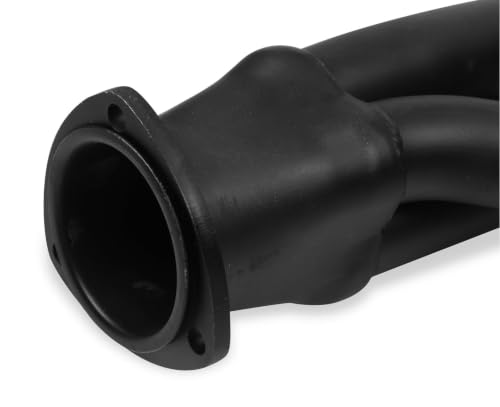
The collectors on the 2466HKR have a 3-inch outlet diameter. For most street applications with engines under 500 horsepower, a 2.5-inch or 3-inch exhaust system will handle the flow without creating backpressure.
If you're running a higher-output engine or planning to add power adders like nitrous or forced induction, stick with a full 3-inch exhaust system all the way back to the mufflers. You can use slip-fit reducers or V-band adapters to mate the collectors to your exhaust pipes depending on your fabrication preference.
Ceramic coating is optional on stainless steel headers. The 304 stainless material already provides excellent heat resistance and corrosion protection without additional coating.
That said, ceramic coating can reduce underhood temperatures by 20-30 degrees in tight engine bays, which helps protect surrounding components like starter motors, wiring harnesses, and brake lines. If you're building a show car, ceramic coating also maintains a cleaner appearance longer than bare stainless, which can develop surface oxidation and discoloration over time.
Shorty headers typically give up 5-12 horsepower at peak RPM compared to full-length competition headers, but they often improve mid-range torque and throttle response because the shorter primary tubes reduce the time between exhaust pulses reaching the collector.
The stepped primary design on the 2466HKR recovers most of the top-end losses you'd normally see with a traditional shorty header. For street-driven vehicles that spend most of their time between 2,000 and 5,000 RPM, the mid-range gains often make the car feel faster even if the dyno sheet shows slightly lower peak numbers.
Replace header gaskets any time you remove the headers for maintenance or engine work. Even if the gaskets look reusable, they compress permanently after the first heat cycle and won't seal as effectively on reinstallation.
For routine inspection intervals, check the gasket seal annually or every 10,000 miles by looking for carbon streaks or soot around the flange perimeter. If you see evidence of leakage, replace the gaskets immediately to prevent exhaust gas from eroding the flange surface or damaging the cylinder head.