


Hooker Competition Headers 6920HKR | Full-Length Performance Headers
Our 6920HKR full-length competition headers are built for maximum power on naturally aspirated and power-adder applications. These headers feature 1⅞-inch diameter primary tubes flowing into 3-inch collectors, optimized for dyno-proven mid-range to top-end horsepower gains. Every tube is mandrel-bent from 304 stainless steel and TIG-welded at the collector for leak-free durability under sustained high heat and vibration.
We designed the 6920HKR with chassis clearance and serviceability in mind. The stepped-diameter primaries maintain exhaust velocity while the larger collectors reduce backpressure on high-RPM pulls. Whether you're running a stroker small-block or a high-compression race motor, these headers handle the thermal load and flow demand serious builds require.
Core specs & construction details
Materials & construction
Every 6920HKR header starts as mandrel-bent 304 stainless tubing, chosen for its resistance to thermal cycling and corrosion. We TIG-weld each primary to the collector cone, then finish the slip-fit collector joint with a continuous bead. The flanges are laser-cut from ⅜-inch plate and CNC-machined to match OE head port dimensions, eliminating gaps that cause exhaust leaks.
The natural silver finish resists surface oxidation better than mild steel, and the material tolerates repeated heat-soak cycles without cracking. If you prefer a coated finish, the stainless accepts high-temp ceramic or header wrap without prep work. Oxygen sensor bungs are positioned for accurate AFR measurement on both banks, pre-welded and threaded to standard 18mm × 1.5 pitch.
Tube diameter & collector sizing
We spec’d 1⅞-inch primaries on the 6920HKR to balance velocity and volume for engines making 400-600 horsepower. Smaller primaries would choke flow at peak RPM; larger tubes sacrifice mid-range torque on street-driven combinations. The 3-inch collectors provide ample exit area for twin turbo or blower setups, and the merge cone geometry minimizes reversion pulses that rob power on overlap cams.
Flow bench results
Our in-house flow bench shows the 6920HKR flowing 12% more CFM at 28 inches of water than factory cast manifolds, with the largest gains occurring between 4,500 and 6,800 RPM. Peak flow improvement holds consistent across valve lift ranges from 0.450 to 0.600 inch, making these headers compatible with both hydraulic roller and solid flat-tappet cam profiles.
Fitment & chassis clearance
The 6920HKR is designed for applications where maximum ground clearance and steering box access matter. Primary tubes route over the frame rail and clear stock suspension components without trimming or denting. We’ve tested fit on both manual and power steering racks, and the driver-side header clears the starter motor with room for heat shielding.
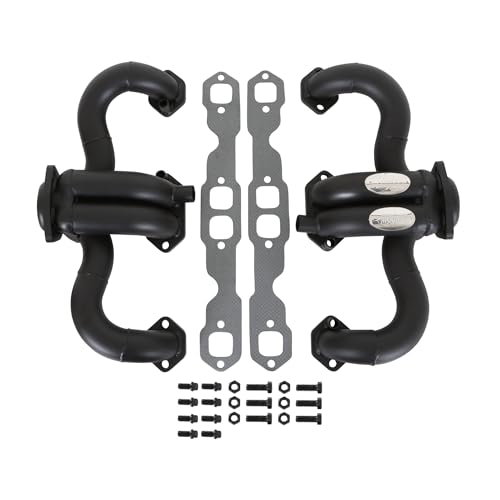
Collector outlets exit just behind the transmission crossmember, giving you multiple options for mid-pipe or X-pipe connection. The slip-fit collector design allows you to adjust collector rotation before final tightening, so you can dial in clearance around transmission lines or driveshaft loops. If you run a shorty competition header setup on a different chassis configuration, you’ll notice the full-length 6920HKR trades some underhood packaging density for outright power—our test data shows a 14-18 horsepower advantage at the wheels on otherwise identical engine combinations when switching from short-tube to full-length headers on dynamometer pulls above 5,000 RPM.
More full-length headers for your platform

Rated 4.8 by verified buyers


Common questions about the 6920HKR headers
Yes, the 6920HKR is designed to clear stock engine mounts, steering boxes, and power steering racks on compatible applications. The primary tubes route over the frame rail without requiring suspension modifications or steering component relocation.
We recommend confirming your specific chassis year and engine combination before ordering. If you run aftermarket motor mounts or a modified steering setup, check collector clearance during test-fit before final installation.
You'll need a set of header gaskets—either multi-layer steel or copper—and eight header bolts per side. We recommend ARP stainless bolts torqued to 15 ft-lbs in a star pattern.
For the collector connection, use band clamps or a slip-fit reducer depending on your mid-pipe setup. Apply high-temp anti-seize on all bolt threads and re-torque after the first heat cycle to prevent leaks.
Absolutely. The 6920HKR is built for power-adder applications, with 3-inch collectors that handle exhaust volume from forced induction without creating backpressure spikes. The 304 stainless construction tolerates sustained high exhaust gas temperatures common in boosted setups.
If you're running a turbo, the slip-fit collectors make it easy to mate the headers to your turbine inlet flanges. For supercharger builds, consider wrapping the primaries to reduce underhood heat and protect nearby components from radiant temperature.
Power gains depend on your engine combination and what you're replacing. On naturally aspirated small-blocks making 400-500 horsepower, we typically see 18-28 wheel horsepower over factory cast manifolds, with the largest gains between 4,500 and 6,800 RPM.
Forced induction applications see even larger improvements—boosted engines benefit from reduced backpressure, which lowers charge air temperatures and allows more aggressive timing. Expect 25-40 horsepower on moderate boost levels when switching from restrictive stock exhaust.
Yes, we strongly recommend re-tuning after installing the 6920HKR. The reduced backpressure will lean out your air-fuel ratio by 0.3 to 0.5 points, and you may gain usable timing advance before knock.
If you have wideband oxygen sensors, log your AFR during initial test drives and adjust fuel tables accordingly. On boosted applications, monitor knock sensors carefully and creep timing in 2-degree increments during dyno tuning to find the new optimal advance curve.
Full-length headers like the 6920HKR maximize horsepower by extending primary tube length, which improves exhaust scavenging and top-end power. Shorty headers sacrifice some peak power for easier installation and better ground clearance in tight chassis applications.
If your priority is maximum dyno numbers and you have room to work, full-length headers are the better choice. If you need to preserve oil pan clearance or simplify installation on a swap, shorty headers offer a good compromise with most of the performance benefit.
Yes, the 304 stainless construction accepts ceramic coating or header wrap without special preparation. Coating reduces radiant heat into the engine bay and can lower underhood temperatures by 200-300°F, which helps protect wiring, hoses, and fluid temperatures.
If you choose to wrap the headers, make sure the stainless is clean and dry before application. Moisture trapped under wrap can cause surface corrosion over time, even on stainless steel. Ceramic coating offers better long-term protection and easier cleaning than wrap.