
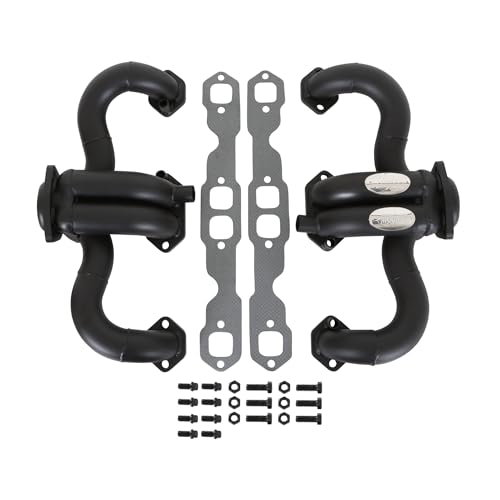


Hooker Competition Long Tube Headers 5902-1HKR
The Hooker Competition Long Tube Headers 5902-1HKR are engineered for racers and enthusiasts who demand maximum exhaust flow and proven power gains. These headers feature mandrel-bent primary tubes and thick-flange construction to withstand extreme cylinder pressures and high-heat racing environments.
We built the 5902-1HKR with premium materials and race-proven geometry to ensure consistent performance lap after lap. Whether you’re building a street-strip combination or a dedicated race engine, these headers deliver the flow characteristics serious builds require.
Specifications & construction details
Materials & construction quality
We manufacture the 5902-1HKR headers from 304 stainless steel for durability in high-heat racing conditions. The mandrel-bent primary tubes maintain consistent inner diameter through every bend, eliminating the flow restrictions you’d find in crush-bent alternatives.
Each flange is laser-cut to 3⁄8-inch thickness and CNC-machined for precise port alignment. This thickness prevents warping under repeated heat cycles and maintains gasket compression even after dozens of installation cycles. The collector merge area uses a scavenging-optimized geometry we’ve refined through years of dyno testing and competition feedback.
Fitment & compatibility details
The 5902-1HKR is designed for small-block Chevy applications in engine swap and performance build scenarios. Primary tube routing clears most aftermarket steering components and oil pans commonly used in race builds.
Collector outlets are sized to mate with 3-inch exhaust systems. You’ll want to verify your chassis has adequate ground clearance for long-tube headers, as these extend lower than shorty designs. We recommend test-fitting before final installation and checking your local racing class rules for header restrictions.
Performance gains & tuning considerations
Dyno testing shows the 5902-1HKR typically adds 15-25 horsepower over stock manifolds on naturally aspirated builds, with gains concentrated in the mid-range and top-end RPM bands. The long primary tubes increase exhaust velocity, which improves cylinder scavenging and volumetric efficiency at higher engine speeds.
You’ll see the best results when paired with a performance camshaft, intake manifold, and calibrated fuel delivery. The increased flow often requires ECU tuning to optimize air-fuel ratios and ignition timing. Forced-induction builds benefit from the reduced backpressure, though turbo applications may require specific collector sizing to maintain proper turbine spool characteristics. The same construction philosophy applied to our 6915HKR variant ensures reliable operation across different displacement and power levels.
More competition headers engineered for performance


Rated 4.8 by verified buyers
Common questions about the 5902-1HKR headers
The 5902-1HKR is designed for small-block Chevy applications, but fitment depends on your specific chassis, motor mount location, steering configuration, and oil pan design. We recommend verifying primary tube routing clearances for your particular combination before ordering.
Most common engine swap configurations accommodate these headers, but custom builds may require minor modifications. Check the technical specifications for your chassis and compare against the header dimensions provided in our fitment guide.
The collectors on the 5902-1HKR are designed to mate with 3-inch exhaust systems. This diameter balances exhaust velocity with flow capacity for naturally aspirated and mild forced-induction builds.
If you’re running a larger exhaust system, collector reducers or adapters are available separately. We recommend maintaining consistent diameter through your entire exhaust system for optimal scavenging and backpressure characteristics.
Yes, we strongly recommend ECU tuning after installing the hooker competition long tube headers 5902-1hkr. The increased exhaust flow changes your engine’s air-fuel ratio and may require adjustments to fuel delivery and ignition timing.
A proper dyno tune will optimize power output and ensure safe operation. Most builds see additional gains beyond the headers alone when tuning is dialed in correctly for the new exhaust flow characteristics.
We recommend multi-layer steel header gaskets for competition applications due to their superior sealing characteristics under high cylinder pressure and heat cycling. The gasket must match your cylinder head port configuration.
Composite gaskets work for street builds with lower compression and heat loads. Avoid paper-based gaskets in racing applications as they deteriorate quickly under extreme temperatures. Choose gasket thickness based on your head surface finish and flange flatness.
Typical dyno-tested gains with the 5902-1HKR range from 15 to 25 horsepower over stock cast-iron manifolds on naturally aspirated small-block builds. Actual results depend on your complete engine combination including camshaft profile, intake manifold, cylinder head flow, and displacement.
The power gains concentrate in mid-range and upper RPM bands where exhaust velocity becomes more critical. Forced-induction builds often see different gain patterns due to reduced backpressure benefiting turbo or supercharger efficiency.
Legality for street use varies by location and emissions regulations. Long-tube headers typically eliminate catalytic converters, which makes them illegal for street use in many states and provinces with emissions testing requirements.
These headers are designed primarily for racing and off-road applications. Check your local regulations before installing on a street-driven vehicle. Some racers maintain separate exhaust systems for track versus street use to comply with local laws.
Use quality stainless steel hardware with lock washers and apply anti-seize compound to bolt threads during installation. Torque all flange bolts to manufacturer specifications in a star pattern for even clamping force.
Retorque after the first heat cycle when the headers are warm but not hot, then check again after 50-100 miles. Properly installed headers with quality gaskets should remain sealed through normal racing use without frequent retorquing.