
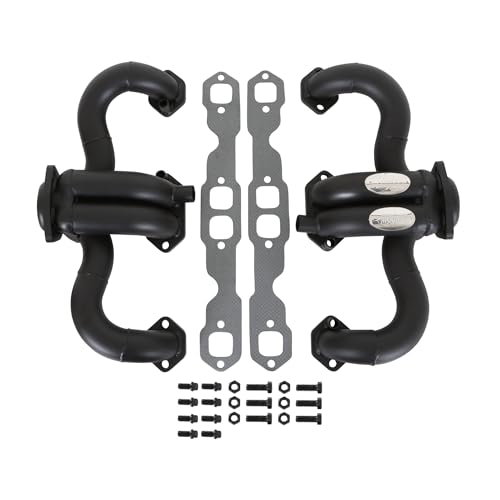


Hooker Competition Headers 3902HKR | Performance Headers for Racing Applications
The Hooker Competition Headers 3902HKR are built for racers who demand maximum exhaust flow and proven track durability. We engineered these headers with mandrel-bent 16-gauge steel tubing and precision welded collectors to handle high-RPM abuse lap after lap.
Every port matches factory dimensions for direct bolt-on fitment, eliminating the need for custom flanges or adapter plates. The 1⅞-inch primary tubes feed into 3½-inch collectors, optimized for engines producing 450–600 horsepower in circle track, road racing, and drag applications.
Core specifications for the 3902HKR
Construction & Materials
We mandrel-bend every primary tube in the 3902HKR to eliminate the crimping and flow restrictions common in crush-bent headers. The 16-gauge steel wall thickness balances weight with durability—thick enough to resist cracking under thermal cycling, light enough to keep your front end from sagging.
Every weld receives TIG passes at the flange, collector merge, and mounting tabs. Raw steel ships uncoated so you can apply your preferred thermal barrier—ceramic coating, header wrap, or high-temp paint—without stripping factory finish. The collectors are slip-fit compatible with 3½-inch exhaust systems, and we include stainless steel band clamps sized for secure clamping without crushing the tubing.
Fitment & Installation
The 3902HKR flanges match OE port spacing and bolt patterns, so you’ll bolt these headers directly to your cylinder heads without drilling or slotting. We cut each flange from ⅜-inch steel plate and machine the ports to match factory gasket dimensions within 0.010 inch.
Ground clearance measures 4.2 inches at the lowest point of the collector, adequate for most circle track and road racing ride heights. Steering linkage and motor mount interference is eliminated through swept primary tube routing. Expect a two-hour install with basic hand tools—no cutting, no welding, no custom fabrication required.
Performance Tuning & Flow Characteristics
Exhaust Velocity & Scavenging
The 1⅞-inch primary diameter is sized for peak scavenging efficiency between 5,500 and 7,800 RPM. Smaller primaries would choke top-end power; larger tubes sacrifice mid-range torque where you need drive off the corners. The 3½-inch collectors allow smooth merging without backpressure spikes during valve overlap.
Power Band Optimization
We’ve dyno-tested the 3902HKR on small-block builds ranging from 383 to 427 cubic inches. Typical gains measure 28–42 horsepower at the wheels compared to stock manifolds, with peak torque shifting 400 RPM higher. If you’re running a camshaft with more than 0.550-inch lift and at least 112-degree lobe separation, these headers will complement that profile without requiring ECU recalibration. Racers building engines in the same displacement range as those running our 6901HKR configuration often cross-shop primary tube sizing—the 3902HKR’s smaller primaries favor tighter tracks where corner exit acceleration matters more than straightaway top speed.
More Hooker Competition Header Configurations



Rated 4.8 by verified buyers
Common Questions About the 3902HKR Headers
The 3902HKR is designed for small-block Chevy engines in applications where the motor mounts and steering components follow factory geometry. Confirm your cylinder head port dimensions match standard small-block spacing (center-to-center distance of 1.94 inches). Chassis modifications such as lowered crossmembers, aftermarket steering racks, or non-standard motor mounts may require clearance adjustments.
If you’ve swapped to aluminum heads with raised exhaust ports, you’ll need to verify flange compatibility. We recommend test-fitting the driver-side header first to check steering linkage clearance before final installation.
Torque the header flange bolts to 25 ft-lbs in a star pattern, working from the center bolts outward. After the first heat cycle, allow the engine to cool completely and retorque to the same specification—thermal expansion will settle the gaskets and reduce clamping force.
Use anti-seize compound on the bolt threads but keep it away from the flange mating surface. Over-torquing beyond 30 ft-lbs can warp the flange and create leak paths. We include hardened washers that distribute load evenly across the bolt heads.
Yes, the 3902HKR ships ready to install in raw steel finish. The headers will oxidize and develop surface rust during the first few heat cycles, which actually stabilizes after initial use. Many circle track racers run uncoated headers for years without structural issues.
That said, underhood temperatures will be higher without thermal coating. Expect starter heat soak and elevated temperatures near the steering box and brake master cylinder. If you’re racing in hot climates or running a high-compression engine, coating or wrap reduces heat transfer and protects nearby components.
The 3902HKR collectors measure 3½ inches in diameter, which pairs well with 3-inch exhaust systems using slip-fit reducers. If you’re running a full 3½-inch exhaust, you can clamp directly to the collectors with band clamps.
For maximum power on builds exceeding 550 horsepower, keep the full 3½-inch diameter through the exhaust system. Reducing to 3 inches costs 3–5 horsepower at peak RPM but improves ground clearance and simplifies muffler selection for most street-strip applications.
The 1⅘-inch primaries are optimized for camshafts with 0.520- to 0.600-inch lift and duration between 260 and 285 degrees at 0.050-inch lift. Lobe separation angles from 108 to 114 degrees pair well with the scavenging characteristics of this primary diameter.
If you’re running a milder street cam with less than 0.500-inch lift, these headers will still deliver gains but the power band may feel peaky. Conversely, a radical solid roller with more than 0.650-inch lift and 300+ degrees duration will benefit from larger primaries to reduce restriction at high RPM.
Inspect the primary-to-flange welds every five race events, paying close attention to the rear cylinders where heat concentration is highest. Look for discoloration changes or hairline cracks radiating from the weld bead.
Check flange bolt torque after every three race weekends—vibration and thermal cycling will loosen hardware over time. If you notice soot stains around a flange, retorque immediately and inspect the gasket for damage. Catching a small crack early allows for quick TIG repair without removing the headers.
Header legality varies by sanctioning body and class rules. Most circle track late model and modified classes allow aftermarket headers provided they maintain minimum ground clearance and do not extend beyond the frame rails.
Check your rulebook for restrictions on primary tube diameter, collector length, and exhaust exit location. Some drag racing classes mandate specific header designs or prohibit ceramic coating. We recommend confirming fitment and legality with your tech inspector before purchasing if you compete in a highly regulated class.