


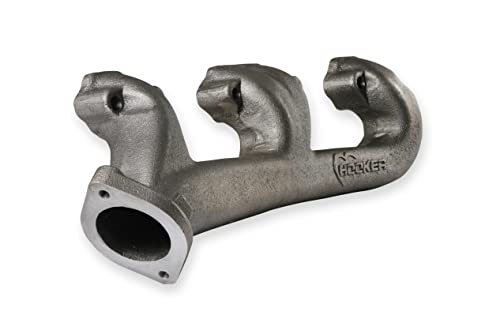
Hooker Side Pipe Headers – High-Flow Performance Exhaust
Our side pipe headers route exhaust gases through mandrel-bent tubing that exits directly along the vehicle's rocker panels, eliminating traditional rear-exit systems entirely. The design maximizes scavenging effect while reducing backpressure by up to 40% compared to cast manifolds.
Engineered for V8 muscle cars and street rods, these headers feature equal-length primary tubes that merge into collectors positioned for optimal ground clearance. The side-exit configuration cuts exhaust system weight by 25-35 pounds and opens up space for other drivetrain modifications. Each header ships with all mounting hardware and heat shields to protect body panels from radiant heat.
Side pipe header specifications
Construction and materials
We fabricate every set of Hooker side pipe headers from 16-gauge type 304 stainless steel, chosen for its resistance to thermal cycling and road salt exposure. The tubing undergoes mandrel bending rather than crush bending, which preserves the full internal diameter throughout every curve and maintains consistent exhaust velocity from port to exit.
Each primary tube measures 1.875 inches in diameter and follows equal-length routing to ensure exhaust pulses from all cylinders arrive at the collector simultaneously. This synchronization strengthens the scavenging effect that pulls spent gases out of the combustion chamber during valve overlap. The collector features a stepped merge design that gradually combines flow streams without creating turbulence, and laser-cut flanges mate to cylinder heads with precision flatness that eliminates the need for gasket sealant in most applications.
Fitment and ground clearance
Side pipe headers require specific chassis measurements before installation. Our headers are designed with 4.5 inches of ground clearance at the lowest point when mounted to factory motor mounts, suitable for street-driven vehicles with stock or mildly lowered suspension. The rocker panel exit positioning places the outlet 6 inches aft of the door jamb to prevent exhaust gases from entering the cabin during idle.
Mounting provisions
Each header includes application-specific mounting brackets that attach to existing frame holes without drilling. The driver-side header routes around the steering box and motor mount, while the passenger-side unit clears the oil filter and starter. Heat shields mount 1.5 inches away from the primary tubes using standoff brackets, creating an air gap that reduces rocker panel surface temperature by 60-70 degrees Fahrenheit during highway operation.
Installation requirements
Installing Hooker side pipe headers typically requires 6-8 hours for a home mechanic with moderate fabrication skills. You’ll need to remove the factory exhaust manifolds, motor mounts, and in some applications the starter and oil filter for access. The headers slide into position from underneath the vehicle, and we recommend supporting the engine with a jack and wood block while you align the mounting points.
Gasket installation follows a specific sequence: position the header flange against the cylinder head without fasteners first, then thread all bolts finger-tight before torquing in a crisscross pattern to 25 foot-pounds. The integrated heat shields bolt to the chassis using existing holes in most muscle car frames. Some builders pair side pipes with fenderwell headers on custom chassis where underbody clearance becomes critical for extreme lowering.
Complete your exhaust system with these performance upgrades


Rated 4.8 by verified buyers


Common questions about Hooker side pipe headers
No frame or body modifications are necessary on most applications. Our headers are designed to use existing motor mount locations and frame bolt holes. The heat shields mount to factory chassis points without drilling in applications including 1964-1972 Chevelle, 1967-1969 Camaro, 1968-1974 Nova, and similar muscle car platforms.
Custom chassis or heavily modified vehicles may require minor bracket adjustments. Lowered suspensions with less than 4 inches of ground clearance may need revised exit positioning to prevent scraping.
Hooker side pipe headers completely replace your factory manifolds and eliminate the need for traditional exhaust pipes, mufflers, and tailpipes. The side-exit design routes exhaust directly out along the rocker panels, so no downstream components connect to the collectors.
If your vehicle requires catalytic converters for emissions compliance, you'll need to install bolt-on catalytic converters between the header collectors and the side pipe outlets. We offer compatible high-flow converter kits designed specifically for side pipe applications.
Proper exit positioning is critical for side pipe installations. Our headers place the outlet 6 inches behind the door jamb and angle the exit 15 degrees downward and outward. This directs exhaust gases away from door seals and window openings.
At idle and low speeds, some exhaust smell may enter through open windows – this is normal for all side pipe configurations. Installing rubber weatherstripping along door bottoms and maintaining positive cabin pressure with fresh air vents reduces fume intrusion. Never run the engine in an enclosed garage with side pipes.
Our headers provide 4.5 inches of clearance at the lowest point when installed on vehicles with stock ride height and factory motor mounts. This measurement is taken at the collector merge point, which is the lowest part of the system.
Vehicles lowered more than 2 inches may experience scraping on steep driveway transitions or speed bumps. We recommend measuring your current ground clearance at the oil pan before ordering. If you have less than 5 inches of pan-to-ground clearance, consider our adjustable motor mount kit that raises the engine 0.75 inches.
Yes, our hooker side pipe headers include provisions for bolt-on catalytic converters. The collector outlets accept 3-inch slip-fit converters that mount between the header and the final side pipe section. This configuration maintains the side-exit appearance while meeting emissions requirements.
Converter placement 18-24 inches from the cylinder head keeps exhaust gas temperature high enough for proper catalyst function. Our complete side pipe systems include CARB-legal converters for California and states that have adopted California emissions standards. Standard 49-state applications can use any universal 3-inch catalytic converter rated for your engine size.
Side pipes measure 8-12 decibels louder than a chambered muffler system at idle and 15-20 decibels louder at wide-open throttle. The shorter exhaust path and lack of mufflers create an aggressive, race-inspired tone. Sound is most pronounced inside the cabin due to the exit location near the driver and passenger seats.
If you need quieter operation for neighborhood driving, you can install removable baffle inserts in the collector outlets. These baffles reduce sound output by 6-8 decibels while creating minor backpressure that costs 3-5 horsepower. Remove the baffles for track days or spirited driving.
Check flange bolt torque every 500 miles for the first 2000 miles as gaskets compress from heat cycling. After break-in, inspect the system annually for loose clamps, cracked heat shields, and exhaust leaks at the flange joints.
Stainless steel doesn't require rust prevention treatment, but road salt and chemicals can cause surface staining. Wash the headers with soap and water after winter driving to remove salt deposits. Inspect heat shield mounting brackets yearly for stress cracks – these brackets expand and contract with temperature changes and may require replacement after 5-7 years of use.